
Woodstock Lagoon
Woodstock Lagoon is a little known place just five minutes out of Longford. A swampy marshland that was protected a number of years ago with the aim of conservation. It sports a variety of bird life, frogs, most likely snakes (though I did not see any) and vast array of plant life. Photographers with a long telephoto lens would capture some great images. My aim for today was to capture a dramatic sky. With the thunderstorm forecast, I wanted to capture a wide angle shot of the storm rolling in. Unfortunately the cloud was not dramatic and I could not settle on a composition to take a landscape image. In addition, the storm would not arrive until two hours after arriving back home. A change in focus ensued from looking up to looking down resulting in me documenting the insect life in the dried grasses scattered with thistles lining the fields adjacent to the marsh land.

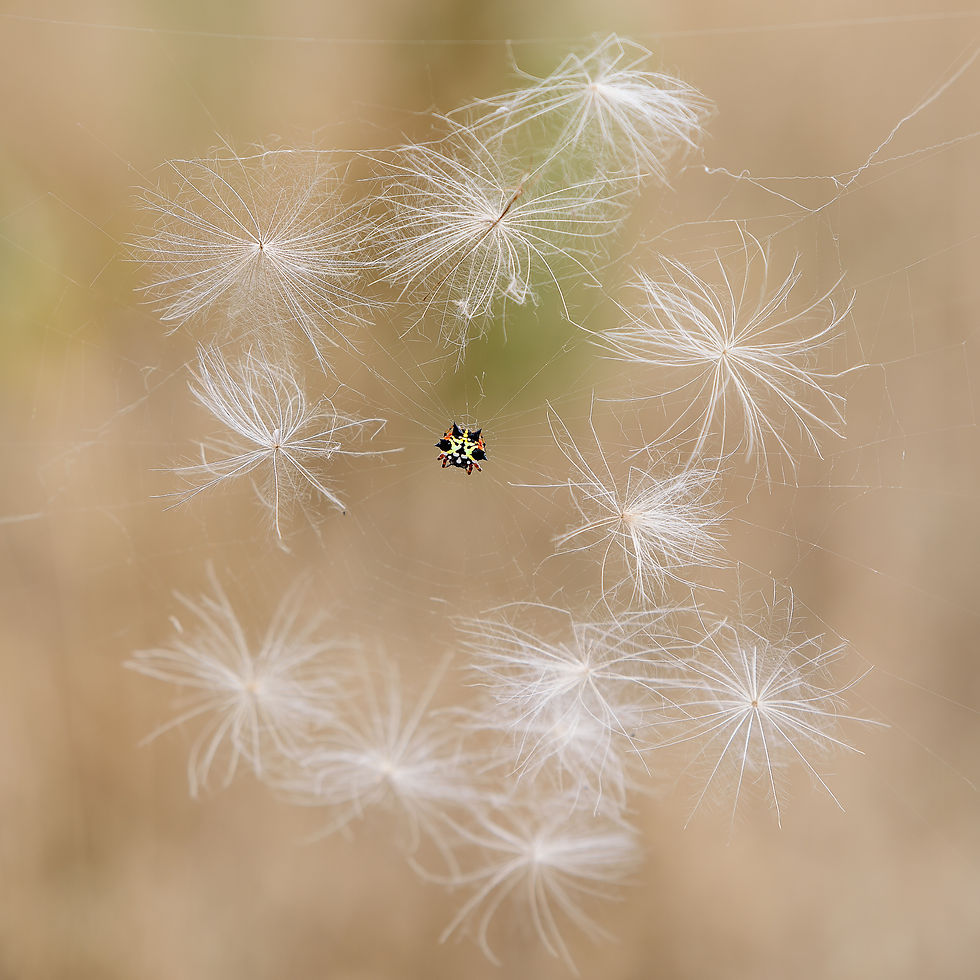
The following image here is of a Jewel or Thorny Spider. The colours in this image do not do it justice. An orb web spider, it anchors its web to neighboring thistle plants. It's back has an almost neon green/yellow look as it reflects the light. This image is one of my favorites with the thistle seeds (fairies as we would call them as kids) naturally frames the subject.
Below is a close up to the above image for a closer look at the finer details on its back.

This next little monster took me by surprise. At this stage, I started looking for a nice little composition of a bumblebee when I stumbled on this beautiful specimen.

I believe it may be a type of Wolf Spider but please post and let me know if you know exactly what it is. What has me unsure is its head to body size ratio. Next is a closer crop to appreciate the size of this spider compared to the bumble bee which was not small.

Among the grasses and wild flowers were an amazing abundance of butterflies. The below image is that of the Small White Butterfly. Their short life span culminating to this spot to meet others to carry their line forward. In my hurry to capture the event, I did not plan my focal plane to ensure focus.

Further down the field, I had a common Brown Butterfly fly past my view and onto a black berry bush. I had left my tripod at my last shooting location. Not having a macro lens, the stabilisation ensures maximum spareness at any given aperture. The 2.8 aperture made focusing on the eyes a little difficult and the hand movement at 200mm, even with stabilisation on, didn't help the sharpness but i am happy with the resulting composition.

Bumblebees have been a common siting in Tasmania for the past ten or so years. First sighted in 1992, it is unknown how they made it to Tasmania but have well established themselves in our environment. This article indicates that someone likely sneaked them into the state for some unknown reason. This was identified through genetics analysis showing the local population descended from two or more queen bees. Though I love the site of them for imagery, they should never have been brought in. Shame on the person who did this, if in fact was the case.

The next image was taken whilst on my way back to the car. I looked down and saw a pale white insect inside a thistle flower. On closer inspection it was a bee barely moving, as if drunk from all the nectar it had accumulated. It was absolutely covered in it.

It is amazing the photo opportunities just five minutes from home. A change in focus from the marsh land to the adjacent fields produced some great images. My drive home, out of the car window produced another composition, one which I will need to visit again with a wide angle lens and a low ground perspective.


Comments