
Liffey Falls with the Nikkor 20mm 2.8D Lens

Before purchasing this lens, I did what most diligent purchasers would do and went online to source user views. Surprisingly I found it quite difficult to find the information I was after including example images. What was discussed in various forums was that it is not known as a sharp wide angle, and the 24mm or 28 mm might be a better and cheaper option. I have had my heart set on this lens for quite some time and wanted to experience it myself so jumped into the purchase after going through the pre-purchase checks on my camera body, a D750. It was immaculate. No scratches or visible dust or fungus in the lens. I could tell it was well looked after by the original owner. This post is for photographers who are looking to buy this lens and would like a first time users experience.
Second hand, this lens sits within a select group of the affordable wide angle lenses available to Nikon shooters. Without dropping $1000-$2000 for a modern, quick, and tack sharp wide angle lens, these lenses can be snapped up between $300-500 AUS used.
The purpose for this trip to Liffey Falls was to test out my new Nikkor 20mm 2.8D lens. My first ‘true’ wide angle. Landscape photography is a joy to pursue and now possessing an adequate focal length, I am now able to set up a composition and take an exposure without the need to pan and combine multiple images through stitching. There had been some substantial rain over the three days prior so I knew there would be a decent flow of water.
Sunday 16th September, 2018
Alarm set 4:15 am. In hindsight, this was cutting it very fine with a 45 minute drive and a 15 minute walk to my destination before sunrise at 6:05. Waking up, and as I do without hesitation every morning, I hit snooze and arose 15 minutes later. Breakfast is without question my favourite meal of the day and as a result of my snooze, I have just sabotaged any decent sit down to relax and enjoy my toast and plunged coffee. Getting the final items in the car, toast on plate and coffee in hand, I set out. Turning from my drive I notice the hint of blue hour beginning. The silhouette of Mount Ben Lomond cast against a dark blue hue. Shaking my head, I was already regretting my 15 minute snooze.
The reason for the early morning arrival is to take long exposures of the little rivulets and waterfalls. As I do not own any neutral density filters, I required the minimal light to extend the shutter. Arriving at the upper car park, I packed away my head torch, as the light was enough to clearly see where I was going, and started my trek into the valley. Nothing beats the smell of Tasmania’s cool temperate rain forest. The refreshing crisp air hits your face and fills your lungs providing an uplifting effect, like the splash of water on your brow on a cold morning. The slow roll of water, like a light rumble of thunder echoing in the distance was filling the silence. Thinking I would be missing my opportunity to test this lens with low light, I wasted no time (some sections running) in getting to the location I had previously scouted.
I was too late but not all was lost. Instead of the shutter speed of between 15-20 seconds, I had to settle for 5-6 seconds for my first image.

Nikkor 20mm 2.8D, ISO 200, f/11, 5 sec
This image is a little soft and only through a little post sharpening could this exposure be usable. It was taken without much thought of composition and can only be considered a test shot. My tripod, vibrating in the water, could not keep the camera still. Thinking of my next location, I wanted to ensure there was an effective foreground in the composition. Relocating a few meters behind I was able to setup the tripod behind a rock. The back water it created was ideal and no visible vibrations were evident in the back screen. The foreground of the small rocky outcrop and the pathway they invoke, I feel, lead the eye into the frame.

Nikkor 20mm 2.8D, ISO 50, f/10, 2.5sec
As a result of the sun rising, I had to reduce my exposure for this image to 2.5 seconds. In order to create the long exposure I had in mind, I shot 17 images and layered them through a process called ‘median averaging’ to get an ‘effective’ shutter speed of 40 seconds. To calculate, take the total number of images and multiply them by the shutter speed. This will provide the ‘effective’ shutter speed.
With the sun reaching over the mountain edges, I knew my time in this location was up and ventured off through the valley in search of another composition, a small rivulet.

Nikkor 20mm 2.8D, ISO 50, f/14, 1.6sec
The walking track that connects the lower and upper car parks varies in width from as little as two feet to developed sections as seen in the below above. Man ferns and moss line the walking track and a soft blanket of tiny flowers cover the forest floor. The following image was taken with a 70-200mm lens at 200mm. The flower had fallen from a tree and gracefully rested in this peaceful location.

Tamron 70-200, ISO 100, f/3.2, 1/13sec
The next image was the first rivulet I encountered. What drew me in was the moss covered log projecting across the stream, and the moss lined rocks along the stream banks. With a full forest canopy, I was required to use a 30 second exposure at f/ 7.1 aperture.

Nikkor 20mm 2.8D, ISO 50, f/7.1, 30 sec
It was this location I took two exposures. One where the fern in the top half on the image was the highlight. The second image was recomposed to focus more on the moss covered rocks and the beautiful fallen white and yellow (possibly tannin dyed) flowers covering them.

Nikkor 20mm 2.8D, ISO 50, f/7.1, 20 sec
This next image was taken at a different rivulet and could not pass by a fallen and broken log. The angle and positioning of the logs and the break really assist the composition.

Nikkor 20mm 2.8D, ISO 50, f/ 9, 10 sec
Now the sun was starting to peak through the forest canopy, like spotlights, only hitting some parts of the vegetation around me. I decided to start my walk back to the car when I noticed one of these beams of light hitting the side of a tree. The light was reflecting off the droplets of water creating an interesting effect that would benefit from a ‘low key’ type image. Using a 70mm long focal length, aperture of f/4 and exposure time of 1/160 sec, I was able to capture just the highlights. I composed it 50/50 for the highlights to fade from center to the left.

Possessing some abstract elements, the following image could be seen as full abstract. Nearly halfway back to the carpark, I turned to the river to notice the soft glow of a yellow and green hue. Walking to the river’s edge, I notice that the bands of colour were made from the darker orange, green plant/algae (from when the river was lower) and the yellow.
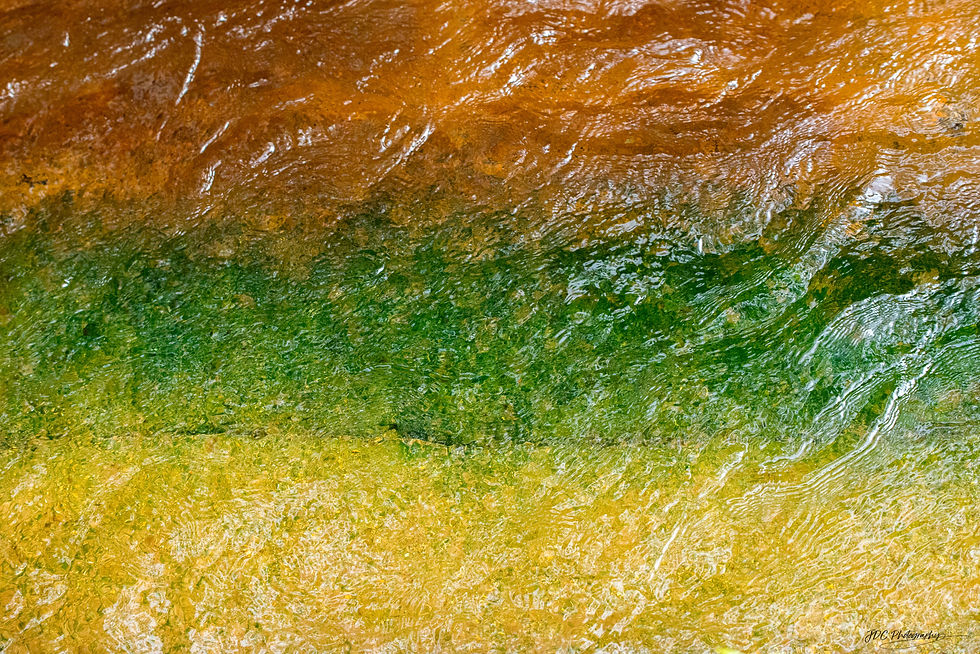
Tamron 70-200 @ 70mm, ISO 3200, f/4, 1/500 sec
This was my last image of the trip. Am I happy with the 20mm 2.8D? Absolutely, the image quality is still adequate to produce great prints.
Image SOOC (RAW format)

Developed
1:1 screen shots
Even though I would consider myself a pixel peeper, the detail at 1:1 is still sufficient (keep in mind, my tripod is a light travel version and still may have had slight vibrations from water current). The sharpness is not as great around the edges. There is also some slight chromatic aberration, as evident on the rocks against the white water.


Comments